Tampilkan postingan dengan label outcast. Tampilkan semua postingan

Rabu, 13 April 2016

Columbia Gorge Fishing Reports June 15th 22nd

0

Fishing Report June 15th
There are plenty of anglers wondering if there are fish in the Deschutes yet…  There are always steelhead in all of our river every day of the year.  It is a numbers game though.  As the summer progresses, numbers increase and so do the chances of hooking up.  I have heard of summer fish being caught on all of the local rivers so far including the Deschutes, but anglers are either spending many, many hours searching for them or getting really lucky. 


We really, really have to watch the water temperatures now.  Salmon have been washing up dead in the Willamettedue to water temperatures above 75 degrees IN JUNE… 

(http://www.oregonlive.com/environment/index.ssf/2015/06/more_fish_likely_to_die_as_hig.html)

This is very bad news and a foreshadowing of things to come.  The Deschuteshit 72 degrees two weeks ago and we haven’t even got to the hottest part of the year.  It has been topping out around 68 or 69 every day this last week, and the Columbiahas been at 67 degrees for a week or two.  Fish mortality is inevitable with sustained water temps above 70. 

Enough of the doom and gloom, on to the report:

American Shad are still moving in the Columbia River right now.  Reports are that the fish are deep (up to 30’), making them more difficult to catch on the fly than in years past when they ran in shallower water.  Guides have been telling me that it is because of the warmer water in the river.  Numbers never really jumped either.  In a year when everything is early, the Shad are either late or not going to show in big numbers.  We were at 2.1 million at this point last year and 1.1 million this year. 

Carp fishing is a great option right now.  The fish are spawning in a lot of areas, but in places where they are not, fishing is steady.  If fish are chasing each other or sitting still in super shallow water in groups, they are most likely spawning.  It will be very difficult to get them to eat.  They are finicky, so finding fish that are actively feeding is going to be the best way to get a fish.  They act in a similar way to bonefish, so look for “nervous water” in muddy, shallow areas and get a Crazy Charlie in front of them.

Rainbow Trout fishing on the Deschutes Riverhas been really, really good for the last 30 minutes of daylight or so.  The caddis hatch has been super.  Caddis hatch in big numbers during low and warm water events, so it should be good for most of the summer.  Just watch the water temps and PLEASE DO NOT FISH when the water is at or above 70 degrees.  http://waterdata.usgs.gov/or/nwis/uv?site_no=14103000

Chinook fishing has been decent below Bonneville Dam, but not smoking hot.  Numbers are great so far for summer fish.  Summer Chinook are traditionally headed for the uppermost tributaries of the Columbia, Snake and Salmon Rivers, but we can catch them as they go through the area.  Check the Regulations before you go out bank fishing for salmon around here as many areas are closed to fishing right now. 

Sockeye Salmon numbers are great, but the odds are stacked against you as sockeye are definitely not into taking flies. 

Summer steelhead numbers are starting to pick up.  While numbers are low for this time of year, we are not overly concerned about steelhead numbers through the dam at this point.  August is when the bulk of the summer fish come through, so early numbers don’t mean a whole lot.   Every local river has fish in it right now, but not very many.  The Klickitat Riverhas been tough, but guys are picking up a fish here and there.  Very few reports coming from the Deschutes, but I have seen proof of fish caught there.  The Kalama Riverand Cowlitz Riverare both good options right now as fish tend to push into the lowermost Columbia tributaries before the Gorge Tributaries.  Upstream Tributaries like the Methow, Grande Ronde and Clearwater tend to get their fish much later. 

The Hood Riveris no different. We won’t see many steelhead until later in the summer.  The smaller a river is, the more likely it is that the fish will be later.  We usually don’t see the bulk of the summer steelhead enter the system until the fall rains come in September or October.  Fish trickle in all throughout the year, but again, steelheading is a numbers game and trying to find one of the dozen or two fish in a forty mile river is not the type of odds that I would bet on. 

The East Fork Hood River is open for trout fishing, as well as the main branch of the river.  It is a nice place to spend a day chasing small, wild, hungry trout.  I would get out there now as the river is a good color and it is going to get too low to fish really soon.  Standard dry flies like the Parachute Adams, Stimulator or Elk Hair Caddis work just fine.  It requires a lot of walking (boulder hopping) to cover enough water to have a really productive day, but there is little pressure and beautiful scenery.  HWY 35 offers most of the access all the way up to Forest Service Road 44, where the river gets a bit too small to fish above that area.  The West Fork Hood River is always closed to fishing, except for the 100 yards or so between the confluence of the East Fork and Punchbowl Falls. 

Smallmouth Bass have been hitting topwater poppers on the Columbia River and John Day River. There are lots of fish to be caught, but moving around is key.  They are either in the area or not and you might have to try multiple spots before you find fish.  Try stripping a big baitfish pattern really quickly over rocky areas for the best chance at catching a big one. 

Rainbow, Cutthroat, Brown and Brook Trout fishing has been great in the high mountain lakes.  There are literally hundreds of lakes within a two hour drive of here.  There are varying species, populations and sizes of trout in the lakes.  Get out a map of the area and pick a lake…

Eagle Creek near Bonneville Dam is a great place to spend the day fishing for cutthroat trout.  Much like the Hood River, the fish are small and hungry, but the scenery is beautiful, and the water is cold.  It is a little bit easier to wade than the Hood, but you are in a canyon and there are not many spots to get on or off the trail down to the river.  Once you are on the creek, it is fairly easy to get around.  

As always, we are happy to talk fishing any time.  Give us a call if you have any specific questions on local rivers, gear, and tactics, or if you just want some encouragement to get out of the office.  


Fish. ON!

Fishing Report June 15th

It is full-on summer in the Gorge, so it is time to get out and enjoy the vast amount of recreation opportunities in the region.  Shad are the fish of the week here on the Columbia, while trout fishing in high mountain lakes is fabulous and smallmouth bass are eating topwater poppers just about everywhere they can be found.  Always check the regulations before going somewhere unfamiliar, or just check to get a refresher on the rules.

WASHINGTON:
http://wdfw.wa.gov/publications/01590/wdfw01590.pdf

OREGON:
http://www.dfw.state.or.us/fish/docs/2015/2015%20Oregon%20Sport%20Fishing%20Regs_r12-11-14.pdf

There is a little redundancy in the report, mostly because not a lot has changed as far as opportunities and conditions go.

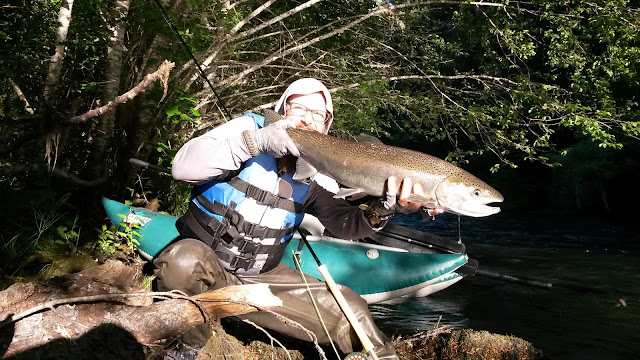
I got out once last week and hit a western river looking for steelhead.  Ryan is new to the area and was looking for his first hot summer fish.  We found one and it was a dandy.  I watched it crush a black muddler minnow near the surface and then fought as hard as any fish.  The look on Ryan’s face will show you how happy an angler can be after landing his first super hot summer steelhead. 

American Shad are still running thick on the Columbia Riverright now.  The majority of the action happens below Bonneville Dam, near Beacon Rock, near Cascade Locks and upstream near Rufus.  If you can find them you can catch them.  They are hard fighting fish that readily take flies and are tons of fun on a 5 or 6wt fly rod.

Carp fishing has been gaining popularity here in the area and there are finally a few anglers (besides Gabe) that have been getting out consistently.  These big fish can be found in the Columbia, but fishing is tough when its been windy on the “Big C”.  Wind kicks up silt and colors the water up, making it tough to fish.  If the Columbia is murky, then try any of the small sloughs next to the highway.  Any pond between Bingen and Lyle most likely has a productive carp fishery and easy access.  Generally, fishing mid-day is good as fish move into the flats and “tail” in the mud for food.  The fish can be easily found in shallow water and have not been moving out until late in the evening. 

Rainbow Trout on the Deschutes Riveris not as productive as it was during “the hatch” but fishing can be consistent for anglers nonetheless.  Anglers must be willing to change flies early and often and do some searching for fish.  Small mayfly nymphs are most likely to work during the day, while having a box full of caddis emergers and dries is a must for the evening hatch. 

Chinook fishing has really shut slowed down in the local rivers, but fish are still moving past us in the big river.  There are rumors of the big “June Hogs” have been circulating though the area from the big boat guys fishing the big river. 

The Cowlitz Riverhas been kicking out some summer steelhead, and is probably the most consistent producer in the Northwest for steelhead through the summer.  Large rivers that have a dam on them should be in better shape than free-flowing rivers this summer as drought conditions strangle the river basins and flows decrease.  Hopefully, the reservoirs on these big rivers have enough water stored to keep flows up and temp down during the rest of our hot summer.  

The Klickitat River is open for summer steelhead, rainbow trout and Chinook salmon.  The action has been pretty good for June.  Typically, the water is high and dirty this time of year and it makes steelhead fishing tough.  The water colored up a lot this past week, but is still fishable.  Reports are visibility varies from one to two feet during the day.  It cycles daily, and depending on how hot it is, certain parts of the river will clear up before others.  Trout fishing can be very good in June, but there are not a lot of guys that are trout fishing…  Meanwhile, there are tons of smolts in the lower river and it is making for tough fishing conditions when a smolt hits your fly several times on every cast.

The Hood Riveris very, very low and has colored up this last week.  There are fresh steelhead in the Hood Riveryear round, but angler effort has been nearly non-existent lately due to water conditions.  With low and dirty conditions; skating a dry fly for steelhead could be productive as fish should be sitting in shallower water (they don’t have a choice).  Typically, the summer run steelhead move into the river in better numbers in the fall when water levels (hopefully) start to increase.

The East Fork Hood River is open for trout fishing.  The access is plentiful along HWY 35, but it is a tough wade due to steep gradient and huge boulder fields.  The trout are small and sparsely distributed, but they are hungry and rewarding due to the amount of effort it takes to get around all of the boulders.  It is catch and release only and no bait is allowed. 

Smallmouth Bass have been hitting topwater poppers early and late in the day on the Columbia River and John Day River. There are lots of fish to be caught, but moving around is key.  They are either in the area or not and you might have to try multiple spots before you find fish. 

Rainbow, Cutthroat, Brown and Brook Trout have been eating flying ants in the high elevation lakes.  The fishing has been really incredible in the past few weeks and should be good for the next few weeks, even though the ant hatch is waning.  The big trout tend to gorge on them later in the day when the bugs start flying heavily.  Damselfly nymphs and callibaetis are also working well, along with smaller chironomids.  Damselflies, Callibaetis and Chironomids will be the primary food source for most of June until the Hexagenia hatch happens at the end of the month.  Timothy, Clear, Trillium, Laurence and Lost Lakes are all great OregonLakes, while Merrill and Goose Lakes are great choices for Washington anglers.


As always, we are happy to talk fishing any time.  Give us a call if you have any specific questions on local rivers, gear, and tactics, or if you just want some encouragement to get out of the office. 

"Fly Fish the World with Us"


Read more

Rabu, 30 Maret 2016

Outcast Commander vs Outcast Pac800

0

Outcast OSG Commander

Frame-less vs. Frame! Do I need a frameless boat?

With the recent resurgence of frameless personal watercraft like the Outcast Commander, Stealth Pro and Fish Cat Scout, many anglers are wondering what the advantages are of a frameless boat compared to a more traditional framed pontoon boat like the Outcast PAC 800. I recently took a trip down the river with an old friend so we could test out the capabilities of each type of boat.

Outcast OSG Commander:

I spent the day rowing and fishing in the Commander. I took it down a small, technical river and then later kicked around a local lake. Why Frameless? I chose the Commander with a specific purpose in mind. There are a couple of rivers that a motivated angler could get a boat into some great water without having to commit to using a traditional boat ramp… I can think of three of four places where dragging a boat in would give me a nice option for a short float that people with drift boats wouldn’t consider going. At 35 pounds, the Commander is easy to manage and handles technical whitewater well.
Got to be motivated to get here!

What I like about the Commander:

It’s quick and easy to set up. It takes about ten minutes to get it from packed in an Outcast Kayak Bag to completely ready to go. I like that I can keep a small collapsible cooler, small dry bag with extra clothing and my fishing gear all behind the seat. There are convenient webbing loops along the seam where the floor meets the tube to tie your gear down. Remember to always “rig to flip” and tie all your gear in.

The boat handles really well. It is very easy to get moving and can handle very technical water with ease. It has a low, narrow profile which makes it easy to get through little chutes and between rocks. I don’t want to mess with class IV whitewater in general, but feel confident that my boat will get through the class II water that we have around here with ease, especially in the summer when the water is low.

One reason I like these frameless boats is that an angler can pull onto a gravel bar and just stand up and fish. The boat does not get away from you as you are standing within it. It is light enough that it does not pull on you much when you are working your way through a spot with the boat holding in the current against your legs. This makes it easy to quickly fish small buckets ad move on to the next spot.

The ability to mount accessories is wonderful. The Stealth Pro and Commander both have two pads that can hold a cargo pocket or a rod holder. It is an easy way to keep your rod and fishing supplies available for quick and easy access.

The ugly:

Effective but different than standard oar lock systems
There are a few things that I don’t like about the frameless boats, all very minor. The first is that the oars and oarlocks. You cannot ship them (pull them in) or feather them (twist the blades as you stroke). As someone who has rowed thousands of miles, my rowing habits (good and bad) are already formed and I don’t like having to change my stroke just for this boat. All of the frameless boats on the market have the same features, and I don’t see them changing it at all. It is really just a minor inconvenience, but it is something I wish were different. I do understand that it would significantly raise the price of the boats to develop a new system.

Another feature that I dislike is the pocket; more specifically, the placement of the “frameless cargo pocket”. There are two pads that are glued onto the boat that accessories (like the pocket or rod holders) can be mounted to. The Stealth Pro comes with one pocket, while it is an accessory for the Scout and the Commander. The pocket is long enough that it gets in the way of the oar on the Commander, but only when you are trying to stow the oar.

The Stealth Pro has the ability to move the pad into three positions. After talking with Greg about his Stealth Pro, he told me that the pocket only gets in the way when the pad is moved into the “forward” position. I have not spent any time in the Scout, but I would imagine that it is a concern also because it is in a fixed position similar to the Commander.

PAC 800

This is a more of a traditional single man pontoon boat. The pontoons are beefy 16” diameter and they have a good rocker. The rocker is the curve on the bottom boat. A bigger rocker reduces the amount of surface area on the water and makes it move faster along with easier navigation. The urethane bladders are a superior material that provides peace of mind (more on that shortly).

Get to places previously unreachable

What I like:

This is a solid boat that is easy to navigate along with sturdy construction that is unlikely to fail. The storage capacity is great. I would feel comfortable with enough gear for a light overnight float. The platform on the back is great for latching and securing gear. It is easy to navigate and sits high in the water. A bigger profile means that it draws less water than smaller boats. More surface area is harder makes it easier to float.

Another benefit is that you sit higher in the water, so your butt is less likely to constantly be wet. This few inches can give you a better vantage point for scouting rapids and spotting fish too.

There is far more versatility with rigging options on a pontoon boat. An anchor is no big deal on a framed boat, while it is possible, but not as convenient on a frameless boat. There are more surfaces and bars to attach straps and gear to, so taking more gear down the river is easier to rig and easier to secure. I would feel comfortable taking enough gear for an over-night excursion on a PAC 800.

The Ugly:

Framed boats are heavier than frameless boats (Stealth Pro and Commander - 35#, PAC 800 - 52#). That is why frameless boats were developed in the first place. There is also more weight to get moving, so you are using more energy for rowing in the first place.

Outcast Wheel System
Another point is that you have slightly less accessibility with a pontoon boat. An angler is more limited where he can take it. Even with the Outcast Wheel System there are places that the PAC 800 would be difficult to get to that would be easy for a frameless boat. The Commander can squeeze through tighter slots and rapids than the PAC800. Chris and I are both extremely accomplished oarsmen and he got the PAC 800 stuck in the middle of a rapid where my Commander fit through just fine.

A boat that sits higher in the water is also more susceptible to being blown around in the wind. The PAC 800 is no exception; windy conditions make it more difficult to row. I once took a pontoon boat out on a lake without the oars (just fins) and ended up having to leave it on the other side of the lake and walk way too far when the wind started blowing so hard I could not kick against it any longer. I had to come back and get it early the next morning.

So do I need a frameless boat?

Storage solution - Outcast Boat Hoist
Well that is up to you. A PAC 800 or PAC 900 are both solid choices, as well as either the Stealth Pro and Commander. I choose these four boats because they have urethane bladders. There are tons of choices out there, but a urethane bladder is the key to a high quality boat. Urethane is much more puncture and tear resistant than Vinyl (as seen in many alternative boats). Urethane also lasts longer and can take a higher psi. Someone asked me if the single bladder on the outer part of the Commander is an issue. Absolutely not! There is only one bladder because the chances of it failing are so poor that it is not an issue. Cheaper alternatives have multiple bladders because there is a greater chance of a failure.

Who is a frameless boat better for?

  • Anglers that use questionable or non-traditional access points.
  • Anglers that want quick set-up if they have to break down the boat
  • Anglers that bring minimal gear
  • Anglers looking for a low-profile, lightweight boat

Who is a pontoon boat better for?

  • Anglers that tend to use more traditional access points. 
  • Anglers that carry a lot of gear
  • Anglers that do overnight or multiple-day floats. 
  • Anglers with a truck/ or a trailer to leave the boat rigged up OR
  • Anglers that can take a few extra minutes to set up and take down

A boat is a big purchase for any angler. It opens up so much more water and opportunity, plus it is just darn fun to run a river. Rowing and navigating is another skill to master that increases your fishing prowess. Learning how the currents come together and being able to float over fish and structure can only give you insight on how to be a better angler.

We are always happy to help you make tough decisions with your precious fishing gear. Please give us a call if you ever have any questions.


Andrew Perrault
Gorge Fly Shop | Product Specialist
541.386.6977


Related Articles

Fly Fishing Pontoon Boats - A Buyers Guide

Outcast OSG Commander Inflatable Fishing Boat

Outcast Stealth Pro Vs. the Competition

"Fly Fish the World with Us"


Read more

 
Powered by Blogger