Tampilkan postingan dengan label old. Tampilkan semua postingan

Sabtu, 21 Mei 2016

The most wonderful mystery

0

A READER in Newport Beach, California, says she would like to know what the Bible means when it says:

 "There be three things which are too wonderful for me, yea, four which I know not:
"The way of an eagle in the air; the way of a serpent upon a rock; the way of a ship in the midst of the sea; and the way of a man with a maid."

Specifically, “Nautigal” wants to know about the way of a ship in the midst of the sea.

Well, ma’am, science has made great progress since those words were written. We can explain an eagle’s flight with aerodynamics. Herpetologists now know how a snake slithers across a rock. Dr. Phil understands all too well the wicked way of a man with a maid (and spares us no details). And that leaves the ship in the midst of the sea, the most wonderful of all the mysteries.

Little ships, and especially little sailing ships, conduct themselves in many different ways in the waves of the sea. You may have experienced them all without giving any particular motion a name or a definition. But one man made a list for us to wonder at.

He is the well-known American naval architect and author, Francis S. Kinney. He held that there were eight motions of a sailboat at sea:

Broaching: Accidentally swinging broadside on to the wind and sea when running free.

Heaving: Rising and falling as a whole with the seas.

Pitching: Plunging and scending, so that the bow and stern rise and fall alternately.

Pitchpoling: Accidentally tumbling stern-over-bow in a half-forward somersault.

Rolling: Inclining rhythmically from side to side.

Surging: Being accelerated and decelerated by overtaking swells.

Swaying: Moving bodily sideways.

Yawing: Lurching and changing direction to either side of a proper course.

I note that the discreet Mr. Kinney refrained from mentioning wallowing and foundering, which has happened in boats I’ve sailed. The foundering was in a small sailing dinghy, luckily, and there was a sandbank nearby. Perhaps Mr. Kinney’s designs never did those things. But he might well have included heeling, which is simply deliberately arrested rolling.

So next time you’re out there, “Nautigal,” take note of what your boat is doing, and at all costs avoid pitchpoling. That’s the most dangerous motion of all.

Today’s Thought

I would rather live in a world where my life is surrounded by mystery than live in a world so small that my mind could comprehend it.

— Harry Emerson Fosdick, “The Mystery of Life,” in Riverside Sermons

Tailpiece
A man rushed into the dining car of a train. “A lady just fainted next door,” he cried. “Anyone got any whiskey?”

Several flasks were offered. He grabbed the nearest one and drained it in one gulp.

“Thanks a lot,” he said, “it always upsets me to see a lady faint.”

(Drop by every Monday, Wednesday, Friday for a new Mainly about Boats column.)

Read more

Selasa, 10 Mei 2016

Savings for old provisions in the GPDO

0


NOTE: For completely up-to-date and comprehensive coverage of this subject, we would strongly recommend readers to obtain a copy of the author’s new book - “A PRACTICAL GUIDE TO PERMITTED CHANGES OF USE” published by Bath Publishing in October 2015. You can order your copy by clicking on the link on the left-hand sidebar of this page.

When I wrote the other day about Article 8 of the GPDO 2015, I mentioned the possibility that there may be some general rule of statutory interpretation which would preserve the effect of the repealed legislation, but I had not had time to look this up.

I am grateful to Fraser Kerr for reminding me of section 16 of the Interpretation Act 1978. Although we are dealing here with a statutory instrument rather than an Act of Parliament, under section 23 (1) the provisions of this Act apply (unless the contrary intention appears) to subordinate legislation made after the commencement of this Act as they apply to Acts of Parliament. Section 16(1) provides that where an Act repeals an enactment, the repeal does not (unless the contrary appears) affect the previous operation of the enactments repealed or anything done or suffered under that enactment.

This is enough, I think, to protect the effect of a prior approval already granted before 15 April 2015, and this provision should also suffice to enable any pending prior approval applications and/or appeals against their refusal to be determined after 15 April, whereupon any prior approval so granted could be acted upon, even though the prior approval application was made under the provisions of the 1995 Order. It would also appear that the relevant provisions (including any limitations, conditions or restrictions) applying to the permitted development in question would be those under the 1995 Order, rather than the 2015 Order, although I am not absolutely certain about this last point.

In other cases, where no prior approval application had been made before 15 April, or in any cases where no prior approval was required (and where development had not commended before 15 April), the permitted development will now be entirely governed by the provisions of the 2015 Order.

So far so good, but I don’t think this answers the second problem which I posed in my last post, namely whether dwelling units (or floorspace) converted under a relevant class in the 1995 Order (e.g. under Class MB) should be counted towards the numerical limit (or cumulative floorspace limit) in the corresponding Class in the 2015 Order (Class Q in the example given). I am not convinced that the Interpretation Act has that effect. In this connection, I also looked at section 18 of the Interpretation Act, but I am not convinced that this section has the effect of enabling the provisions of the former classes of development in Part 3 of the 1995 Order to be read as if they were equally applicable to the corresponding new Classes in Part 3 of the 2015 Order. But I am open to persuasion on this point.

This last issue is perhaps more important, from a practical point of view, than the first point I raised. I am assuming for the time being that I am right in thinking that the numerical and floorspace limits in respect of development carried out under the 1995 Order do not affect development subsequently carried out under the corresponding provisions of the 2015 Order, but (as before) I would welcome any comments from readers on this point.

[P.S. I wrote this piece before I had seen Tom Bright’s comment, which has now been published under the previous post. I will take a look at the other point he raises, regarding Article 4 Directions, and come back on this subject in a future post.]

© MARTIN H GOODALL

Read more

Jumat, 06 Mei 2016

Making Sawdust

0

The whole process of building a boat involves cutting a lot of lumber, but at the beginning there were whole days of doing nothing but.

The plans called for kiln-dried or air-dried lumber of no more than 12% moisture.  I live in the hills of Northern California which at times is like living in a rain forest, so that seemed unlikely.  In terms of what species of lumber, what tree: there was a long list of species that would work and a long list of ones that would not.  Doug fir is the most commonly available light, strong construction lumber on the west coast and was on the okay list.  So this began with a treasure hunt to find just the right lumber to build the frame of the boat that would not be ridiculously expensive.


The reason for the specificity of tree and moisture content of the lumber had to do with the epoxy that would be used to bind it all together.  Every joint and every plywood seam and every place where plywood contacts a member gets epoxied. Epoxy wont bind well if the lumber is green, wet, or is of a species of wood that is high in natural oils.

After a little research, I found that our local lumber company, what used to be San Lorenzo Lumber (now ProBuilt), had in one of their yards kiln-dried Doug Fir that was not much more expensive than the green wood they normally sell for construction.  Sweet.  Three hundred dollars of wood later, my old work truck was loaded with boat lumber and headed up to E. Zayante where the boat was being built.


Generally, I had big long 16 and 20 foot 2x4 lengths.  The boat has a 20 foot long top deck, and because of the rake at the ends, is 16 foot along the bottom.  There are also 8 foot long beams across the boat ("athwartship" in boatbuilding-speak) and a bunch of little stuff that would be ends, posts, etcetera

But the plans called for ripping every piece to some new width, some 3 inches wide some 2-1/2.  A finish 2x4 from the lumberyard is actually 3-1/2 x 1-1/2 with smooth rounded corners.  Instead of taking a half inch off of a side to make a 3 inch thick piece, the plans called for taking off a 1/4 inch on either side.  The reason for this is sensible:  Cutting off the rounded edges of the lumber makes a better joint when it is epoxied.


So we spent a whole day feeding 16 and 20 foot long lengths of lumber into the tablesaw... twice. We made lots and lots of sawdust.

Then we cut a bunch of stuff to length, labeled it, and voila.  At the end of the day, we had a pile of lumber that we intended to turn into a boat.

Read more

Rabu, 04 Mei 2016

Learning to trust your crew

0

A sailor I know told me the other day that he is hesitating about buying a bigger sailboat because he’s afraid his usual crew — his two teenage daughters — won’t be able, physically, to handle the bigger craft.

Now I am too streetwise to get into an argument about the capabilities of women, but I was reminded that several years ago I wrote a column on this very subject. I dug it out and gave it to the worried sailor; but it struck me that the advice I handed out then is still valid today. Here it is:  

A FRIEND OF A FRIEND is dreaming of crossing the Pacific under sail. He normally holds down a highly technical and well-paid job, but he’s out of work right now and not likely to be hired again until the economy improves.

However, he is a frugal man and has husbanded his resources. So now he’s thinking that this might not a bad time to turn his dream into reality.

His loyal wife, who crews for him on their 32-foot cruising sloop, is happy to go along with him, but he is worried about his two daughters, aged 16 and 14.

“If they were boys I wouldn’t have a moment’s hesitation,” he says, “but I’m not sure girls will be able to handle the hardships.”

Well, I don’t know these daughters of his, of course, but I can’t help thinking it’s a bit old-fashioned to regard girls as lacking in the ability to handle crew duties aboard yachts. What they might lack in brute strength they surely make up for in ingenuity. You only have to be able to read to know that girls of 15 and 16 are sailing bigger yachts than his around the world on their own these days.

Besides, boys don’t always make idea crews anyway. The last time I crossed an ocean with a son, who was then 17 years old, I lost a lot of sleep worrying about him.

As we were the only two watchkeepers, he had specific orders to call me if he spotted another vessel at night. He had specific orders to call me if he thought a sail change was necessary. He had specific orders to wear a harness and tether when he was alone in the cockpit at night.

But he was 17. He was becoming a man. He couldn’t help himself. Nature was pumping testosterone through his tissues. He didn’t obey any of those orders. Although he was color blind, he guided us through a fleet of fishing boats one dark night way out in the South Atlantic while my wife and I slept below. I nearly had a fit when I found out.

And when we were running fast in the southeast trades I was woken up one night by the thud of footsteps running forward along the cabintop. My untethered son was jibing the foresail singlehanded, shifting the pole from one side to the other. I lay awake, staring into the darkness, listening to the noises, waiting for the thuds that would indicate he was returning to the safety of the cockpit. But they never came. Had he gone overboard? I reasoned — I hoped — that he had returned along the side deck. I wanted to get up and peek out of the companionway hatch, but I didn’t want him to know that I had caught him in an act of disobedience because that would have forced me to impose disciplinary punishment or else lose my power of authority over him, such as it was. So I lay there fretting for another half hour until it was time to go on watch and I could decently make an appearance. And there he was, sitting in the cockpit, neatly buckled up and looking the picture of innocence in the moonlight. I could have bitten him. But I didn’t ask him why the jib pole was suddenly on the other side.

I don’t think a girl would have disobeyed her father/skipper like that. Girls don’t have the same impulse to prove they’re macho.

Or do they? Maybe now I’m the one who’s acting old-fashioned. Well, if I am, I can’t help it. Old-fashioned is what I am. Like it or lump it. But my advice to the friend of a friend is simple: Go for it. Invest some trust in those daughters of yours. I’m sure it will be amply repaid.

Today’s Thought
A man who trusts nobody is apt to be the kind of man nobody trusts.
— Harold Macmillan
Tailpiece
Did you hear about the short-sighted moth that blundered into a 2-year-olds birthday party? He burned his end at both candles.

Read more

Jumat, 15 April 2016

These old boats deserve better

0

I’M ALWAYS AMAZED when people selling boats won’t take the time and effort to clean them up a bit before inviting buyers to look at them. I’ve inspected two boats in the past few months, and quite frankly I was disgusted at the state they were in, despite the glowing descriptions in the advertisements.

Admittedly, I’m searching the cheap and nasty end of the boating spectrum. What I want is an inexpensive daysailer/weekender on which I can teach my grandkids to sail. They know the rudiments already, of course, and they’ve taken a few lessons, but I would like to teach them the real stuff that will keep them interested in sailing for the rest of their lives.

In particular, I’m looking for an old Santana 22, simply because I once restored one from a 28-year-old wreck. I discovered all her weak spots and now know where to look for trouble. Over a period of years, June and I sailed her from one and of the Salish Sea to the other, and we were delighted with her performance as a “sport cruiser,” as I called her.

But the two Santana 22s I found for sale on Craigslist last year were simply not worth looking at. One, described as “awesome” and well maintained had a keel that was a mass of rust. There were bits and pieces of mysterious boat stuff strewn all over the main cabin and the forepeak, rust streaks on the paint, ripped and deflated upholstery, aluminum chainplates bubbling with a white encrustation, and a mast support beam that was bowed downward. The other boat was much the same, but it had also suffered the “improvements” of a series of owners with their own lubberly ideas of what a small sloop should look and behave like.

I don’t know how many prospective buyers must have been put off by the state of these boats, but I would have been ashamed to put them on the market in that condition. I know we’re talking about boats that are nearly 50 years old, but I can’t understand why they can’t at least have been kept clean and tidy and smelling sweet. Nobody expects an old boat to be perfect, but to present a boat for sale in such a slatternly run-down condition is an affront to the person expecting the “awesome” boat of the advertisement. It actually hurts me to see good, well-designed boats so badly neglected. There are years of life left in them yet. They surely deserve better.

Today’s Thought
I love everything that’s old: old friends, old times, old manners, old wine.
— Goldsmith, She Stoops to Conquer

Tailpiece
“How did you knock this pedestrian down, sir?”
“I didn’t knock him down, officer. I stopped to let him cross the road and he fainted.”

(Drop by every Monday, Wednesday, Friday for a new Mainly about Boats column.)

Read more

Minggu, 03 April 2016

First Build Day Building Form

0

After months of hemming and hawing over plans and possibilities and uncertainties and even driving to the Middle of Nowhere to get a trailer, finally we start building the boat.  Or at least we build something that is essential for building the boat.


The Glen-L plans call for making a building form upon which to build the boat.  With the building form you get the boat at a height you can work on it, as well as have a level, plum, and square form upon which to assemble the individual pieces.


From these photos you also get an idea of just how beautiful a location we have to build the Shantyboat  Thanks to Lawrence and his family for their generosity, and perhaps their healthy curiosity as they watch the project slowly come together from a pile of lumber to a boat.


I actually found an error on Glen-Ls otherwise flawless building plans.  The plans called for the cross spalls to be 97", which is one inch over 8 (a frustrating waste of conventional length lumber).  Another measurement in an end view gave half the measurement of the cross spall as 3-11 1/2", or 95 inches. As usual after a little back and forth clarification, I got a message from Gayle:
Wes,

I had Glen take a look at the plans and heres his
response:

Seems to be an error. The cross palls should
extend 3 11-1/2" each side of CL or 95" long. You
have thickness of side planking, plus FG plus rub
rail to obtain beam of 8 2". This will make an 8
width on the bottom to match the two 4 wide PW
panels.

Gayle Brantuk

This building form was mostly made of scrap lumber.  The stringers (the frames of the boat that run longitudinally) will sit on top of and perpendicular to these cross spalls on top of the building form. 


I actually built the form wrong, at least according to the plans (the side pieces are reversed inside out).  And though it didnt hurt anything, it set me off on a cascade of self-recrimination at my carelessness.  If I assembled the boat with as little attention to detail, I would be wasting material, causing undue frustration, and making an ugly boat.

This made me rethink ways I could balance my eagerness with my sense of precision.  The next week I switched gears from my cavalier construction of the building form to a slower more careful approach.

Jen and Kai both helped me make the building form.  And after Kai and I had a pretty pointless conflict, I realized one very important boatbuilding need that I hadnt taken into account for people working hard in the hot sun all day:  Snacks!

Read more

Kamis, 17 Maret 2016

Going Old School Click Pawl Reels

0

Hardy Clickers

Reel technology has improved by leaps and bounds in recent years.  From stacked disc drags to fully sealed, saltwater-proof drags; there are a ton of choices in reel platforms out there.  All of the fancy drag systems out there have benefits that provide an edge to the most skilled anglers.  Sealed drags are the latest and greatest systems out there.  They are impervious to sand, silt and saltwater, giving anglers a peace of mind that there will likely never be a problem with their reel.  It wasn’t long ago that cork drags were the latest and greatest, offering the smoothest function of any reel.  Before that, the latest were conical clutch systems which were preceded by stacked disc drags and previously by drum brakes.  But in the beginning, it all started with the click pawl. 


Hardy Bougle
Most modern anglers go for the latest, most modern system, or at least the most modern that they can afford.  Let’s be honest, people love having the greatest, newest technology out there.  That is why people stand in line for days in order to get the new iphone when it comes out. 

But some of us are cut from a different cloth.  I believe that some of the best reels ever made are still made today in much the same way as the very first production fly reel designed in 1874 by Charles Orvis.  His click pawl reel was the benchmark for countless generations of fly reels, and not much has changed in click pawl reel design since then.  Now the gold standard in classic fly reels across the world is the Hardy Perfect.  It has been made in Allenwick, England since 1891 and almost nothing has changed in its design because it is Perfect. 

The mechanics of such a simple design leave little room for failure.  The pawls (triangular pieces of metal) in the frame click against a gear on the spool that prevents the reel from overrunning if moved quickly.  There is little to no stopping power on click pawl reels.  While the pressure that it takes to move the pawl can be adjusted on some models, running fish should be slowed down by applying pressure to (palming) the spool.  Anglers can almost never blame a lost fish on a drag that was too tight or too loose on a click pawl reel, nor will you see anglers fiddling with the drag knob at crucial moments, because there isn’t much that can happen between the loosest and tightest setting on a click pawl reel.  Lost fish can only be blamed on an angler’s own lack of controlling the pressure on the reel.  It does take more skill to control the pressure on a click pawl reel, but it takes one back to the simpler times long ago where it was just man vs. fish.
Inside the New Pflueger Medalist

The original reels only had one pawl, forcing anglers to retrieve with only their right hand.  The biggest change in click pawl reel design in the past sixty years is the addition of a second pawl so that anglers can change their reel from right to left hand retrieve.  One pawl or the other is engaged by turning it so that the teeth interact with the gear while the other pawl sits at an angle so that it is not functioning.  Another adjustment in design is the addition of an “adjustable drag”.  It is a simple addition; a small tensioner pushes against the pawl to increase the pressure that it takes to move the gear.  There is not much difference between high and low pressure (hence my quotation marks), but it is enough to give anglers peace of mind and to quell the doubters. 

Hardy Bougle

Now the best part of a click pawl reel...  Why I love them so much:  the sound.  Oh the sound of a screaming click pawl reel cannot be paralleled!  A digital recording of a screaming Hardy Perfect was set as my ringtone for a couple of years, but just made me want to fish too much every time my phone rang.  Now, I have had anglers in the shop compare the sound of a click pawl reel to nails on a chalkboard.  For them, I suggest a quieter reel like a Bauer or a Galvan.  Not everyone needs a reel like this. 
 
Hardy Bougle


Why else should you buy a click pawl reel?  You’re buying a piece of history. The Perfect has been made by Hardy since before any of us were born.   The Hardy BouglĂ© and Lightweight series have been around since before WWII.  The Marquis is one of Hardy’s newer reels, although it has been in production since before the founding of most other reel companies in existence.   

There are some newer click pawl reels on the market, and they also have the same worry-free drag, awesome sound and classic look as the old stand-bys.  Hardy introduced the Duchess last year in both trout and spey sizes.  They are simple, yet elegant and look just as good on the water as they do in the store.  They are also a bit lighter in weight than a Perfect or a Bougle. 

Hardy is not the only game in town when it comes to click pawl reels, even if they are by far the top dog on the street.  Abel has been building their TR trout models since the mid 1990s, and their Classic, Spey and Switch reels since 2012.  The cool thing about Abel reels is the multitude of color and porting options to choose from.  You can customize your reel to the last detail while still getting that classic click pawl experience and the finest craftsmanship, perfect machining and unparalleled attention to detail. 
Abel Classic Spey and Switch Series

Yes, it’s true, click pawl reels are not just for steelhead fishermen, although that is where the majority of our sales go.  As mentioned earlier, Hardy has been making their lightweight series trout reels since the 1930s, with four models to fit any of your trout rods. And Abel’s TR models are beautiful reels with a classic design; but there are more options out there. 

 
Pflueger Medalist mounted to a Fenwick Fenglass
Most seasoned anglers have owned a Pflueger Medalist at some point, or at least have seen them at a garage sale.  I have two old Medalists; one of them is from the 1940s and still works just as smooth as it did on the day it left the factory in Akron, Ohio.  The original Medalists used a drum brake system, which was one basic engineering move above a click pawl, but far less complex than any type of disc brakes that we see today.  Pflueger, which is owned by Pure Fishing, the same parent company as Hardy, re-introduced the Medalist this past year, and the new model incorporates a click pawl system instead of the old drum brake.  This is the most affordable click pawl reel in the store and comes in trout sizes too, plus they look pretty darn cool on the new fiberglass rods.

Galvan Brookie on left and Sage Click on right

Other companies offer a modern hybrid version of a click pawl reel.  Sage’s new Click series reelsfeature a composite pawl that is quieter, yet just as smooth and efficient as a traditional reel but with large arbor design and modern looks.  Galvan’s Brookie reel features a Click-Ball system that is similar to a click pawl design but with modern bearings, smooth operation and a similar, modern, large arbor design.  Both of these reels are top-end alternatives to the traditional click pawl reel but with even smoother function and a quieter click. 
Hardy Marquis

I have heard concerns from anglers about using click pawl reels for trout.  They are afraid that delicate tippets will break easily because of the “startup inertia” required to move the pawls.  A couple of thoughts on this:  In the past one hundred years, tippet strengths have increased dramatically while engineering abilities have improved substantially.  Anglers back then caught plenty of fish on poorly machined reels bought at local drug stores using the weakest of tippets.  Abel, Hardy, Sage and Galvan are big names in reels today.  Many of their best small stream trout reels are click pawl (or similar) designs.  This should give you a little comfort in knowing that these systems have been designed by the best reel manufacturers in the world and after more than a hundred years, they are still the go-to reels for some of the best anglers on earth.

The only thing that has really changed that would hurt an angler fishing light tippet for big trout is a fast, stiff rod.  If you prefer a fast rod for sneaky trout fishing, I would suggest reading Ryan’s article on Soft Rods and Light Lines There is a lot to be said for the capabilities of soft rods when it comes to casting at, hooking and playing big fish on light tippet.  His article is definitely worth the read. 

Maybe a click pawl reel isn’t for everyone and I am ok with that.  I still own plenty of reels from names like Ross, Bauer and Lamson and I will continue to collect reels like my girlfriend collects shoes.  But when I am looking to find that reel that I will never sell to put on the one rod that I will own until I die, there is only one thing for me to do, and that is to go old school.   

Read Soft Rods and Light Lines


Andrew Perrault
Gorge Fly Shop | Product Specialist
541.386.6977


"Fly Fish the World with Us"


Read more

Selasa, 15 Maret 2016

Gearing up for Meat Eating Trout

0

meat eater

Hi, my name is Ryan and I have a streamer problem.

Some would say I have an addiction. 

Some would say it’s not “real” fly fishing. 

Some would say you might as well fish with a spinning rod. 

I would say bite me!

 I have been a die-hard streamer guy for over a decade now and I will do my best to try to explain why and how I am setup for slinging big flies to monster trout.

There are 3 reasons I have become a streamer junkie:
  • Streamer fishing is active fishing or what they would call power fishing in the tournament bass world. You are casting and moving a lot, and really looking for fish that want to play ball. It isn’t a finesse game, but it will work when you can’t move fish other ways. 
  • Streamer strikes are often vicious and jarring. Once you have felt a few big trout crush a sculpin pattern it is hard to go back to watching a bobber… 
  • Streamers will move the biggest fish in the system. If you want to catch big fish regularly, then you better learn how to feed them some meat! 

Sculpin pattern
There are some important things to think about when considering the whys, whens and hows of streamer fishing. If you think about a simple energy used to energy gained equation, it is easy to understand why a trout would eat a sculpin, dace, leech, or another trout. How many midge larvae does it take to equal the calories in one sculpin? A bunch, I would say. Another crucial aspect of streamer fishing is understanding territorial behavior and reaction strikes. Trout, particularly large trout, will defend their area even if they don’t eat what they attack. Large trout will also strike invaders for no other reason than instinct. If a big “thing” is suddenly slapped in front of them or jigs right through their field of vision, they will often strike with malicious intent.

There are many ways to fish a streamer, and I can’t possibly cover it all here, but there are a few major categories: slapping the bank, swinging, and jigging/twitching. As you dive into the streamer chucking realm you will find out when and where to use each of these, and often I will use all of them in the same day. Now don’t get me wrong, if there is a good steady hatch I will put the streamer rod down, but when the insects aren’t prolific, you will most likely see me with a leech or sculpin on my rig. And I can tell you that I have caught as many sporadically rising trout on a well placed streamer as any dry fly I have tried to present.

Meat Locker

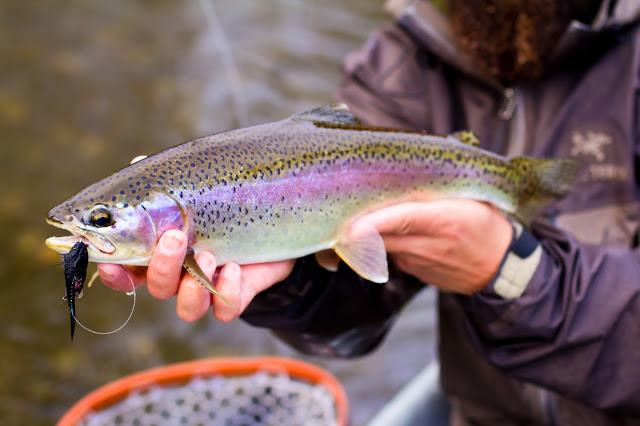
Rainbows on the Yakima River
So let’s get down to brass tax; gearing up for the streamer game… Let me start by saying that you can fish streamers on any trout rod and line you already own, but a dedicated streamer rod will make your life easier, and give you the ability to fish effectively, especially with bigger flies. For me, a single hand trout streamer rod should be a 6 or 7 wt that isn’t too fast. Some of my favorites are the Winston BIIIx, Sage ONE, and G Loomis NRX. I know these are top end rods, but trust me, you want a rod that performs well and is light enough to cast all day when you are throwing big flies. The fly line is equally as important as the rod. For most western rivers you will need a sink tip line. My favorites are the RIO InTouch Outbound Short full floater (WF6) and intermediate/type 6 sink tip (WF6I/S6), the RIO InTouch Streamer Tip intermediate and type 6 and the RIO InTouch 15ft Sink Tip type 6. Of these the 15ft sink tip is the most versatile and the outbound short is easiest to cast. I prefer the type 6 tips for all of these because I rarely if ever wish my flies would sink less, but often wish I could get deeper.

Winter Brownie

Now let me tell you that not all streamer fishing has to be aggressive and with big flies. Fishing a streamer in smaller water or quiet pools requires some finesse and working the fly in a seductive manner. For smaller water, i.e. spring creeks, small freestones and slower tailwaters, etc. you will like a shorter rod in a 5wt as it will really help your accuracy and will load quickly. There aren’t as many choices in short 5wt rods these days, but a few I can recommend are the Loomis Shorestalker 8ft 5wt, the Scott G2 8’4” 5wt and the Winston 8’6” 5wt BIIIx. If you are in really small water or fishing for smaller fish don’t hesitate to throw small streamers on your 7’6” - 8’ 3 or 4wt too! You will also not typically need a sink tip line for small water, but a good all purpose line should get the job done.


Trout Spey Chronicles
Microspey, trout spey, small ball, whatever you call it, trout sized spey/switch rods have changed the streamer chucker’s game for good. How I would have killed for one of these rods 10 years ago. The ability to make long casts with big flies and sink tips across a river and into that deep slot has always been the bane of a streamer nut, but we did it anyway. Now we have rods and lines that can do it with nary a thought. If you find yourself deep in the throes of streamer addiction, grab a trout spey rod from Winston, Sage, Loomis or Echo, put an Airflo Streamer Switch or OPST Commando head in the appropriate size and a T-8 through T-11 tip and huck meat!


Sculpins
Reels for the streamer game need not be too complicated, but having a good piece of equipment that won’t fail you when you hook a monster, is wise. Some of my favorites are the Tibor Back Country Wide, Lamson Litespeed, Ross Evolution and Galvan Torque in the appropriate sizes. I try to avoid very heavy reels as it is a bear to cast with those all day. Just make sure you have something that is dependable.

Leader and tippet should be fairly short and strong. I rarely use anything less than 8# or 3x for streamers and mostly 2x or 1x. I am a big fan of fluorocarbon tippet, but for the most part good mono is just fine. Leaders on your sink tip setup should only be 3-6ft long with a heavy butt section to help turn over your flies. I like to build my own with Maxima or heavy Rio shock or saltwater tippet in 30-50# and then double uni knot to my tippet off of that.

Streamers are as varied as the anglers that fish them, but my most successful flies have been heavily weighted rubber legged buggers, bunny leaches, and big articulated sculpins. My favorite fly, one I dubbed the Mohawk, is a bunny or squirrel strip/bugger mutant. It can be tied with a cone, bead, or dumbbell eyes, but it should be fairly heavy. Some other really good choices are the sculpzilla and skulpin bunny. Colors should range from natural olives, tans and browns to bright colors like yellow and chartreuse, but the go to when all else fails is black.

BB - Before Beard

The bottom line is this: if you want to try a new technique, or are sick of watching a bobber, or want to find out what the biggest fish in your local water is, grab a big meaty streamer, drop it in and find out!
If not...Then Bite Me!

The Bearded Pescador


Ryan Van Duzor
Gorge Fly Shop | Product Specialist
541.386.6977


"Fly Fish the World with Us"


Read more

 
Powered by Blogger