Tampilkan postingan dengan label a. Tampilkan semua postingan

Minggu, 22 Mei 2016

Motor Well A Mini Project Unto Itself

0

Oh, the motor well.  Seems simple enough.  Build a box that bolts to the back of the boat, upon which the motor clamps.

Ive been working on the motor well since the days of the Troublesome Skegs and before the Boat Flip.

Turns out that though this earns only a brief paragraph in the Glen-L Waterlodge instructions, it is really quite time consuming.


And though the motor well shows up on various views in the plans three times, it still leaves a lot of unspecified dimensions. Despite a lot of fancy maths including tangents and the Pythagorean theorem my first effort to suss out the missing dimensions and angles was a loose collection of mismatched angles and incorrectly cut two-by stock.


The challenge of the motor well is that there are few right angles, several that are very close, but not quite 90 degrees, several similar obtuse angles and some crazy acute angles. The difficulty lies in translating perfectly good angles and lengths to actual measurements and cuts.


My second attempt -- salvaging as much of the previously cut wood as I could -- discarded the mathematical approach and did it the way a carpenter would. Rather than cutting the two-by stock first, I marked out the known angles and measurements on plywood, solving the unknowns as I went along.  I cut out the 5/8" plywood giving me a useful template that would be used for the sides of the motor well.  Finally, I measured and marked the two-by members to match the template. Magic!


After fitting everything best I could, I epoxied everything together to give me two assembled sides to the motor well.


This was a logistical challenge similar to assembling the side stringers -- you want to align the two-by members facing up, but the screws need to go in from the other side.  In this case, the motor well sides were small enough I could assemble the two-by members facing up on saw horses, then put a few screws in from the bottom to hold them together.


After that, I flipped them over and screwed the shit out of them.  All done while everything -- drill, screws, wood, hands -- are covered in sticky goo. Fun!


I completely encapsulated the wood inside the motor well with epoxy to protect it from decay.


I know from experience assembling boxes, it is easy to discover in the end that youve created a parallelogram that doesnt fit your last side.  How to prevent this?


I temporarily screwed the bottom on the motor well to square up the sides before assembling the rest of the box.  Im using wax paper to prevent the epoxy from accidentally adhering the bottom.  In fact, the bottom wont go on until after the motor well is already bolted on to the hull to allow me access to the bolts.


Now, I can go ahead and epoxy and screw on the back and the framing members.


We have to bolt this thing in with 5/8 carriage bolts no greater than six inches apart.  Turns out thats a lot, really.


I marked the bolt holes and drilled from the outside of the motor well using a carpenters square to get holes perpendicular to the rake of the hull.


Sixteen bolts for this 2 foot square box hanging off the back of the boat.


The heads of some of the carriage bolts would fall on angled members, and so needed to be countersunk.


I needed to temporarily hang this thing so I can mark the bolt holes on the hull.  I built a little support jig that took into account the missing bottom piece.


Here is the motor well on the boat.  Fancy.


Using a wax china pencil, I marked the bolt holes for mounting the motor well.


It seemed like madness to drill 16 holes in my previously watertight boat hull.  Soon, well finish the outside of the motor well and bolt it on.

Read more

Sabtu, 21 Mei 2016

A Real Sharpie

0


Our Panama skiff was very handy, and I had been reading Chapelle; thus, when we arrived in Alabama, with its big reservoirs on the Tennessee River, I decided to build a sharpie. Real sharpies have two masts and are over 20 long. I designed a sharpie 20 1/2 long by 6 wide (4 beam at the chine). In order to achieve considerable flare to the sides while keeping a fairly upright bow, I used conic projection. One apex below the bow and another amidships and lateral to make the transition front to aft. Again, I was able to calculate all lengths, offsets, and angles beforehand, thus not needing a strongback building form. However, handling sheathing panels over twenty feet long was challenging just from their size. The same mathematical techniques were used in shaping the sail panels as had been for the hull. To achieve balance between two sails and a pivoting centerboard, I used temporary mast steps, which could be adjusted, until after some trial runs; then I bonded them in place permanently. If you look at the shadow of the straight boom on each sail, you can see an almost perfect airfoil curvature, reflecting the shape of the sail. However, I made one big error. I was unable to find good information on the proper draft-to-chord ratio for sails, so I guessed. I used a draft-to-chord ratio of about 1/14 and later discovered that a 1/9 ratio would have been more appropriate. Thus, my sails were never able to develop the power that they should have, and the boat was not as fast as its potential.

Read more

Jumat, 20 Mei 2016

A thing of beauty is a job forever

0

WHEN I LIVED in South Africa I once owned a 30-foot boat that had bulwarks, a caprail, and a rubrail made of beautiful hardwood. I couldn’t help myself, I varnished it. And varnished it. And varnished it.  That hot sub-tropical sun burned through the varnish as if it were melting butter. Every six months I rubbed it all down and put on another two coats of varnish. But, man, it looked beautiful. People walking past in the marina used to come to a sudden halt and stare at it in awe.

Eventually, though, the inevitable happened. I got sick and tired of varnishing. I was also intending to sail that boat to America and I had plenty of other preparations to attend to. I had just about decided to paint all that nice wood a suitable buff color that looked almost like varnish from 20 feet away when I noticed the brightwork on another similar boat a few berths away. It was a lovely shade of honey teak, a transparent matte finish that always looked as if it had just been applied.

I saw the owner on board one day and asked him what kind of varnish he used.

“It’s not varnish, it’s Deks Olje,” he said. “It’s Norwegian magic. You just wipe it on with a rag. Rub it well in, all over, and you’re done. Just let it soak into the wood and dry. You don’t have to bother with fancy brushes and there’s no trouble with wind or dust.”

I couldn’t get to the boat store fast enough. I bought a large can of Deks Olje, which, lacking any knowledge of Norwegian,  I confidently translated as Deck Oil. The instructions claimed it was the “easiest maintenance system afloat,” a protective traditional wood oil, an alkyd-urethane resin. I was thrilled to have discovered it. 

I spent a week removing all the old varnish from my woodwork and sanded it smooth. It was a lot of work. I then applied three coats of Deks Olje with a clean rag. Nothing could have been simpler. Sure enough, it looked magnificent. It wasn’t shiny like the old varnish, but it had a deep, warm luster that enhanced the color and grain of the wood.

We went sailing offshore on day trials shortly afterward, and within two weeks the combined efforts of hot sun and warm salt water had devastated my Deks Olje. It looked terrible. Half of it appeared simply to have been washed away, leaving bare wood already going grey. Much of the rest had turned white, as if it were encrusted with some kind of chemical salt.  Needless to say, I was spitting mad.

I went back to the owner of the boat down the way. “My Deks Olje is a disaster,” I said. “How does yours stay so nice?”

“Oh, my Zulu house servant does it,” he said. “He comes down once a week and just applies a fresh coat. It’s the simplest thing. Takes him half an hour.”

”Once a week?” I said. “You mean, every week?”

“Yes,” he said. “Surely you have a servant?”

We sailed for the USA shortly afterward. I gritted my teeth and let the sun and waves remove the rest of the Deks Olje, which they did with remarkable efficiency. The brightwork weathered to a dignified silver grey and needed no attention at all.

Six months later I bought a can of good old-fashioned tung-oil varnish when we got to Fort Lauderdale, Florida, and treated the wood to the old familiar routine. Once again, it looked magnificent and I sold the boat a few weeks later. I didn’t tell the new owner how soon he would have to re-varnish. I figured he was just lucky I hadn’t slapped on another few coats of Deks Olje.

Today’s Thought
 I cannot pretend to be impartial about the colors. I rejoice with the brilliant ones, and am genuinely sorry for the poor browns.
— Winston Churchill, Painting as a Pleasure

Tailpiece
“Your wife tells me she found out you dated an eye doctor in Alaska.”
“No, no, that was no eye doctor. She was an optical Aleutian.”

(Drop by every Monday, Wednesday, Friday for a new Mainly about Boats column.)

Read more

The Cabin Has a Floor

0

Lets put in a floor!  This is the floor that will be inside the cabin.


Remember the beautiful old redwood I got from the chicken shed that Jen, Kai, Alex and I salvaged last year? I wanted to use these thick 1x12s for flooring in the boat. The also have the advantage of putting some weight down into the hull of the boat.


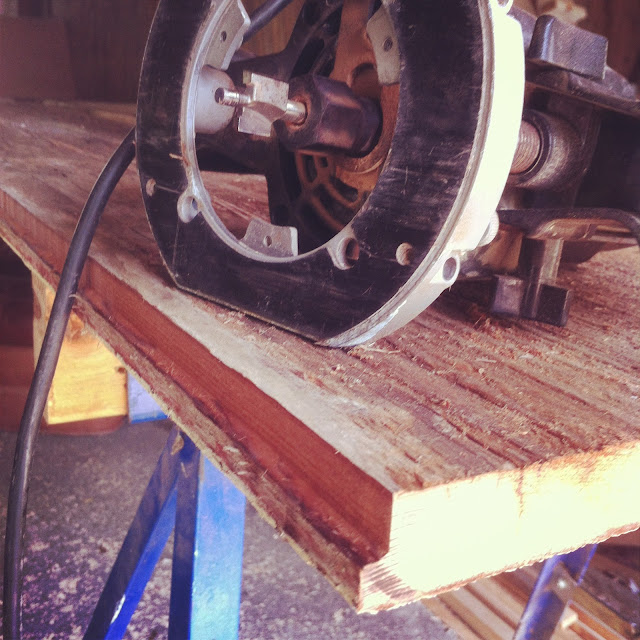
I had a worry that using straight boards for floorboards, there would be little cracks between them that would constantly filter dust into the bilge and possible squeak when you walked on them. So I had the idea to route the edges to make them lap each other.


Ten boards, eight foot long, two edges each. Thats a lot of routing.


Actually, none of the boards were eight foot long, so they had to go in piece by piece.


I used construction adhesive and exterior nails to secure the flooring down. The adhesive will keep the flooring from squeaking and slowly coming up. Modern construction adhesive is so strong, that when you take up plywood that has been adhered down, it comes up in pieces.


It ended up having a neat look.


I wanted to put hatches wherever I could under spaces that were not occupied by fixed objects such as the head, the galley, and the woodstove. After the first three boards aft, I had to start getting strategic with my flooring installation.


It slowly came together. I tried to make the hatch covers match the surrounding boards best I could.


Heres a really bad idea: Using wood that has been nibbled by termites. Some of the wood when I routed it, not only revealed whole termite empires, but actual live buggies.


I went to the lumber yard and drenched everything in Copper Green. This is a special (and more expensive) clear preservative. By clear they actually mean, kind of a deep amber -- but thats preferable to the bright green of the regular stuff.


After all the flooring and the hatches were in, I attacked it with the belt stander, knocking down edges and leaving the different shades a bit more uniform.


I quite like how it came out. I made mismatched hatch handles for each of the four hatches. Can you spot all four?


Heres one of the adorable little hatches open.

Read more

In praise of beautiful overhangs

0

I FOUND A PROFILE of a Pearson Vanguard in a boating book the other day and I couldn’t help but be struck by how beautiful she was. That man Philip Rhodes could design a mean sheerline. Combined with low freeboard, Vanguards still look gorgeous 50 years or so after they were built.

The bow, in particular, has a cocky sheer and a rounded profile that seems just right for a seagoing boat, while the stern rises just enough to complement the wonderful curve that sweeps from fore to aft as befits a creature intended to live among waves.

By today’s standards, the overhangs are excessive. The bow and the stern overhangs measure more than 10 feet combined on a boat only 32 feet 7 inches overall. But today’s boats have traded beauty for utility and interior space, which is a compromise not necessarily for the better.

Designers tell us that overhangs enable a boat to go faster. They increase the boat’s waterline length as she heels, and waterline length, as we all know, is the major factor affecting the maximum sustained speed of displacement boats. I have never been convinced of this alleged benefit. Not for any good mathematical reason but just because I can’t believe it makes enough difference in waterline length to matter. I’m even suspicious about the very claim that heeling adds to waterline length. Some boats roll buoyantly upward, out of the water, as they heel. I bet they don’t add much, if anything, to the wetted waterline. And besides, when you’re running downwind, and not heeling, there is no gain in waterline length at all.

In any case, I personally don’t think the Vanguard’s overhangs are excessive. Another famous and very handsome design of that period, the Camper & Nicholson 32, had overhangs totaling 9 feet. Furthermore, L. Francis Herreshoff, the great master, designed what he called “sensible cruising boats” with overhangs very much like the Vanguard’s. His famous H-28 ketch, at 28 feet overall, had a waterline of just over 23 feet.

There’s no doubt, though, that very long overhangs are dangerous at sea. They’re very elegant, but on smaller boats they’re suited only to sheltered waters. They cause pounding at the bow and slamming at the stern.

A friend of mine once took his 30-Square Meter to sea. This was a narrow-gutted formula racing class with very long overhangs, because the goal for naval architects was to design the fastest sailboat you could build with a maximum of 30 square meters of sail area. My friend got caught in quartering seas and found that the leverage afforded by the long stern overhang caused each overtaking swell to spin the boat almost broadside on, into a dangerous broach. Those 30 Squares were gorgeous to look at, and extremely satisfying to sail to weather, but they were lousy seaboats in bad weather.

The Vanguard was designed in the days when the Cruising Club of America (CCA) rule applied, of course. When that rule was superseded by the International Offshore Rule (IOR), the rear ends of racing boats suddenly changed from generous, flowing, callipygian sterns to mean and tight pinched-in haunches, often with unsightly reverse-sheer transoms. This did nothing for seaworthiness or looks. It just helped a boat get a better handicap under the IOR formula.

Manufacturers of cruising boats, like lemmings plunging over the cliff, followed the style of the racers, of course, in the hope that prospective clients would be impressed. So we had a very ugly production run of racer/cruisers in the 1970s and early ’80s. Happily, though, there were the occasional standouts, like Pearson and Philip Rhodes.

I feel thankful to them every time I see a Vanguard.

Today’s Thought
Perhaps the greatest difference between the beautiful yacht and the plain one is the way their crews treat them, for the crew of the beautiful yacht usually gives her tender loving care.
—L. Francis Herreshoff

Tailpiece
Overheard at the yacht club bar:
“My dirty bottom is really wreaking havoc with my performance.”
“Yeah, just imagine what that would do to your boat.”

Read more

Rabu, 18 Mei 2016

Finding the right balance

0


A READER in Anchorage, Alaska, who calls himself or herself “Iceberg” asks if I could repeat a column I recently wrote about balance in sailboats. Well, I don’t remember writing about that subject recently, but I did write about it many years ago. So here’s hoping that this is what you’re after, Iceberg:


THERE ARE MANY DESIGN FAULTS that sailboat owners will admit to, but unseaworthiness is not one of them. A skipper might well shrug off a lack of accommodation. He or she might well agree the boat is slow, or hard on the helm. But nobody wants to own an unseaworthy boat.

Seaworthiness is the happy result of a lot of factors but there is one that is often overlooked. It’s called balance.

According to Tony Marchaj, a sailor, pilot, naval architect, and research scientist, “Almost by definition, seaworthiness cannot be achieved if the boat is badly balanced.”

So what do we mean by balance? That question was answered by a famous British designer, J. Laurent Giles. He said good balance is “freedom from objectionable tendencies to gripe or fall off the wind, regardless of angle of heel, speed or direction of wind.”

He added that a well balanced boat had an easy motion in a seaway, that is, she passed easily over the waves, neither tending to plunge the bow deeply into the next wave ahead, nor throwing her nose high in the air as a wave passed the fore body. She would also unfailingly lift her stern to a following sea.

“One requires of the balanced yacht that she should retain the utmost docility and sureness of movement in manoeuvering at sea, in good or bad weather,” he added. “She must maintain a steady course when left to herself, but must be instantly responsive to her helm so that the heavier seas may be dodged if circumstances permit. She must be capable of being left to her own devices, sailing, hove-to, or under bare poles.”

That sounds like a very tall order to me. What sort of hull has this wondrous quality of balance? Here’s Marchaj again:

“In a narrower sense, this means that the inherently balanced hull does not substantially alter its longitudinal trim, and does not alter its course during the process of heeling and rolling.” In other words, to be well balanced, a hull, when heeled, should immerse about the same volume of topsides forward and aft.

Marchaj points out that many of the good old boats still sailing now were either designed for, or affected by, the old International Offshore Rule, which produced shallow, beamy hulls with pinched bows. “Usually, when they heel, the stern is lifted and the bow falls. Consequently, these boats are difficult to control by rudder and are unseaworthy.”

If the bow digs in as the boat heels, a boat will try to round up into the wind, of course, not only because of the wedge effect of the forward sections but also because the center of lateral resistance has moved forward while, at the same time, the center of effort of the sails has moved outward and gains more leverage. This is when the person at the helm suddenly finds the tiller up under his chin. Not that it does much good if the boat heels too far and the rudder comes out of the water.

Luckily, most of us don’t often sail in sea conditions that challenge the full seaworthiness of our boats. But if you should be of a mind to cross an ocean or sail around Cape Horn, balance might be a good thing to keep in mind as you search for the right boat.

Today’s Thought

Everything splendid is rare, and nothing is harder to find than perfection.

— Cicero

Tailpiece

“Are you allowed to smoke at school?”

“No.”

“Are you allowed to drink at school?”

“Of course not.”

“How about dates?”

“Oh, dates are fine, as long as you don’t eat too many.”

Read more

Heres what to give a sailor

0

A few years ago some of my landlubber acquaintances asked me what they should give for Christmas to their friends who own boats. I responded with a column of advice. I’m not sure that it did any good, but I’m thinking there’s no harm in repeating it now. So here goes: 

TINKLE-TINKLE, TINKLE-TINKLE. The man with the kettle is reminding us to give, and give generously. This week there will be sailors all over the world who are receiving Christmas gifts from non-sailors. And it is to the non-sailors that this column is directed.

All right . . .  listen up now, you lot. What are the traditional gifts a non-sailor like you gives a sailor? I’ll tell you: a couple of battens for the mainsail. A stainless shackle or two for the bosun’s bag. A woolly watch cap for cold weather . . . let’s face it folks, I’m sorry, but this is not generous giving. The sailor in your life deserves better.

Now, heavens above, before you protest, let it not be thought that I am a purveyor of ingratitude. I believe as much as the next man that it is more blessed to give than to receive. I, too, believe it’s the thought that counts. I also believe that you should give according to your means and I am an ardent admirer of fiscal responsibility, thrift, frugality, prudence, parsimony and similar human traits that Mr. Roget reminds me of in his thoughtful Thesaurus.

On the other hand, the problem facing us today is that your average sailor does not want a silly hat or another mainsail batten to add to the pile of spares already cluttering the cockpit locker. What he really wants is a couple of gallons of anti-fouling paint at $150 a gallon. Or a 35-pound CQR anchor for $600. Or a new color GPS chartplotter for $800. Or a jib furling system for $2,000. Or a new diesel engine.

Yeah, wow, a new engine. That would please him no end. That would make a really good Christmas present. Ten thousand ought to do it. Fifteen, maybe if they have to build new engine beds as well. It sounds like a lot but it’s not really, honestly it’s not, when you consider the huge amount of joy it will bring. A really huge amount of joy. Honest.

It’s not too late to correct your Christmas mistakes. If you haven’t been generous before, you can be generous now. Tinkle-tinkle. Do your bit to make a sailor happy. Truly happy. Tinkle-tinkle.Give till it hurts. Tinkle-tinkle. I mean, really hurts. Tinkle-tinkle. On behalf of sailors everywhere, I thank you and wish you a Merry Christmas and a prosperous New Year. 

Today’s Thought
Money-giving is a very good criterion . . . of a person’s mental health. Generous people are rarely mentally ill people.
— Dr. Karl A. Menninger
Tailpiece
“What’s that you’re burying?”
“Oh, just one of my chickens.”
“Chicken be darned. That looks like my dog.”
“Yeah, right, the chicken’s inside.”

(Drop by every Monday, Wednesday, Friday for a new Mainly about Boats column.)

Read more

Wood Decking

0


The plywood under-decking was bonded in place with temporary staples to hold it until the epoxy hardened. Then the plywood was trimmed around the sheer and cockpit. The process was repeated with cypress planks, about 3/16" thick. Now the planks have been sanded. Finally starting to look like more than just the hope of a boat. I need to glass the stern, recessed transom, and splash pan before glassing the deck itself.

Read more

A Collection of Photos from a Non Shantyboat River Float

0

I took a two-week break from building the shantyboat to float the Sacramento River. I post this here, because floating on these big rivers is where I got the craving for living on a shantyboat.

Some of my favorite times are from drifting aimlessly in our DIY raft during hot summer days. These rafts were themselves kind of shantyboats, equipped as they were with a comfy couch, a driftwood and canvas cabin, a library, a shisha pipe, houseplants, all the comforts of home. But I remember moving this giant craft with no keel around on the river with canoe paddles.  Totally exhausting after a while.


This time down the river, Kai and I went a lot lighter, opting for a simple canoe and a kayak. And because I just dont know how to leave well enough alone, I was going to experiment with a DIY outrigger on the canoe for stability.


We were bringing Hazel Dog along, so (thanks to Bonnie) we had a doggy life vest for her.


Heres our mountain of stuff, including the kayak borrowed from cousin Brian and Hazel Dog in the background.


It all finds its way into the truck.


A five hour drive to Redding from where we were going to launch. Google maps shows it as just over four hours, but when you dont dare go much over 60 mph, it takes longer. Kai looks placid in this photo, but her expression belies the fact that she is terrified of my truck with good reason.


Readying our stuff at the boat launch at Turtle Bay in Redding. This was the first summer that the gianormous diversion dam at Red Bluff had been left open to allow the river to flow freely (Yay, salmon!). So unlike previous trips where we had started in Red Bluff below the dam, we could start 50 miles further upriver and see the gorgeous section of river between Redding and Red Bluff.


Kai proudly shows off her ingenious DIY shade structure she constructed out of PVC and bamboo for the kayak. It probably saved her life since she is a pale redhead that shrivels up and dies under the heat of the sun. It also made me envious and self-recriminatory that I had not spent a little time constructing a similar shade for my canoe.


The outrigger worked beautifully.  An eight inch sealed PVC tube crossed with timber bamboo and secured with bike innertubes.  The normally-tippy canoe was solid as a rock.

The doggy life vest did not make Hazel happy. But she only had to wear it during our initial first few scary moments on the river and later when we encountered anything gnarly.

Shes normally pretty spry, but the tight vest left her unable to sit or curl up of jump or frolic. She just kind of stood there looking at us pleadingly. She looked a bit like the Michelin Man.

It was a simple life of reading and floating and occasionally paddling out of the way of snags and other hazards.


Camping along the rivers edge on sandy verges.


Fishing.  We caught two little trouts.  One on a treble spoon and one with creepy little helgamites. We returned them to the river.

The helgamites came out at night and crawled over us as we were trying to enjoy our campfire. They are like hyper earwigs that were bitten by a radioactive millipede.

They do not normally calmly perch on your finger for a picture as in this photo.  Normally they would be running balls-out either under a rock or up your leg into your shorts to hide.


For three nights, a storm kept us at a sweet improved DIY campsite we found along the river. We pciked lots of blackberries and ate them for dessert and breakfast.


As always, going down the river, various fisherpeople, boaters, and well-meaning fools, filled us with dread and dire misinformation about all the hazards we had yet to encounter.  As it turned out, in retrospect, some of the first whitewater we encountered up near Redding was the most difficult.  Whether that was because of the intensity of the river or our relative inexperience, is hard to know. But going down river, people -- and our maps -- concurred that the terror of the Chinese Rapids was the most dangerous stretch of the river.

Now true, the river was running high, and so some dangerous sections of the river were little more than riffles, and other mellow sections were dramatic, but still. Id say the section of the river around the Chinese Rapids required us to remain alert, but did not offer us the Seven Shades of Death Served Up Cold and Wet we were promised.


It was however, intensely beautiful. A volcanic lava rock canyon, twisted into a dramatic S-bend, with harrowing jagged boulders erupting out of the stream. We were too busy to take photos of the most scenic part of the trip.


Red Bluff has always been kind to us when weve rafted the Sacramento. We camped near the I-5 bridge at the north end of town near a disc golf range.


We took a little vacation from our vacation, stocking up on used books, fishing tackle, and cafe breakfast, all of which were superb in Red Bluff.

The town rekindled my fantasy of a month- or more-long writers retreat in some obscure little town, Red Bluff a definite candidate.


After Red Bluff we tackled another one of our feared hazards: the decommissioned Red Bluff diversion dam.  In summers past, the gates of the dam were down, making it easy to draw water from the river for agricultural projects and forming a lake for Red Bluff summer recreation.


We only had a vague notion that it was save to pass under the dam, with some vague conflicting information from people whose job we believed was to know, park employees, river outfitters, and so on.  It turned out to be less hazardous than passing under standard bridge pylons. But more dramatic, as you can see.


As weve done almost every year, we brought way too much food. But we cooked up amazing and delicious grub. There really is nothing else like the smell of bacon and onions and garlic frying outside.


Sometimes the wind would mess with my little camp stove and Id have to improvise. I called this Stove Henge.


Rocking the River Amish look.


After our few days of stormy rain, the heat wave began. I love sun. I love hot. But anything that "feels like 119 degrees" is a bit much for me. 


I had a little shade umbrella that Id found at the last minute, not imagining Id need it. It wasnt nearly enough. With Hazel panting like a freight train, I felt bad and gave her the shade of the little umbrella.


Our camp spots became strategic opportunities to hide in the shade of scant willows from the searing ball of fire in the sky.


One midday afternoon, we hid in the riverside jungle from the sun.


We camped on little islands and enjoyed the cool of the evenings.


When we stopped at Scottys Landing near Chico for a lingering lunch, unexcited to go back into the heat, we started considering alternatives. Kai the fog-loving sun-hater was reasonably comfortable under her clever shade structure.  I was lethargic and dehydrated and sunburned.  The projection was for many more days of even hotter weather.

This was transportation alternative number one.


This is alternative number two. I caught a ride into Chico and waited around for the Grey Dog to take me back to Redding. Meanwhile, Kai lolled around with Hazel at the swimming hole before breaking down the boats and schlepping all our shit from the boat launch to the side of the road.  I got back down to Scottys with the truck and was able to pick up her and our mountain of stuff. It was still 98 degrees at one in the morning.

That night we stayed in the ridiculous cushy comfort of a cheap Chico hotel. Air conditioning and a cool shower and soft beds made a pretty sharp contrast to the previous week on the river, though not nearly as scenic.

Mission accomplished.  We didnt drown and we didnt roast.

Read more

 
Powered by Blogger