Tampilkan postingan dengan label warning. Tampilkan semua postingan

Rabu, 04 Mei 2016

Jurassic Lake! Estancia Laguna VerdeEstancia Laguna Verde

0


Freakishly huge trout!

flies, nymphs, streamers
and yes even dries!

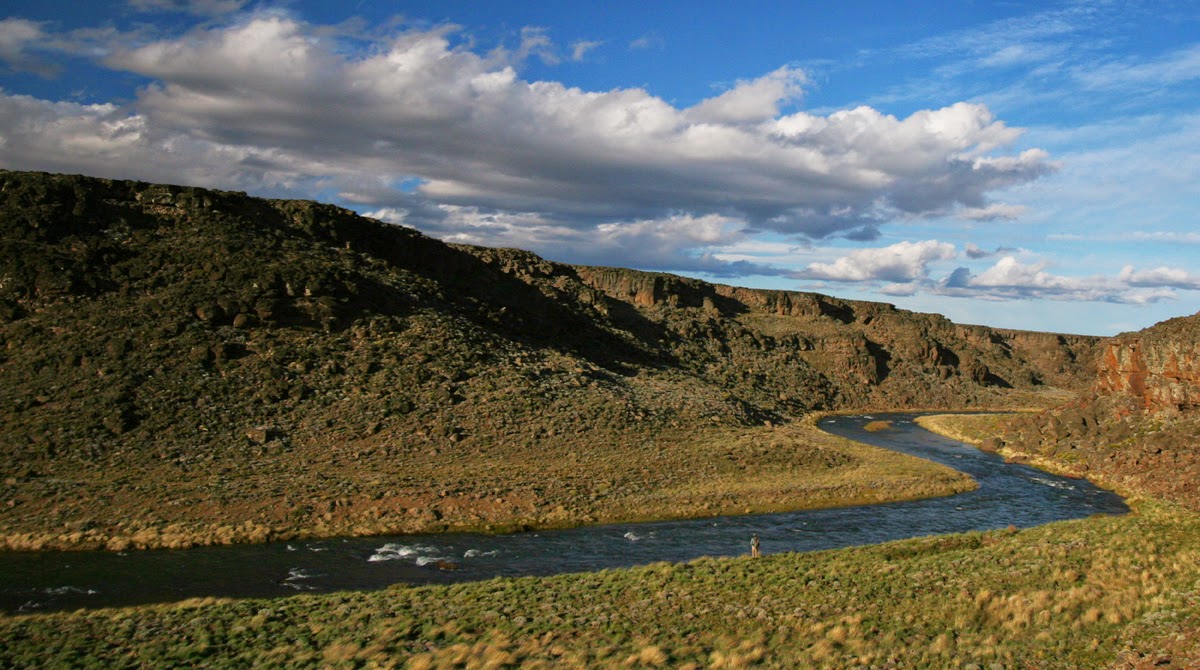
There is a lake in southern Argentina called Lake Strobel. It has been dubbed "Jurassic Lake", but it is really “slab city”. It has freakishly huge trout as does the river that feeds into it. Imagine catching 5 to 10 lb fish as an average, with the possibility of a trout over 20lbs! These trout got big by eating a lot and often. They do eat flies, nymphs, streamers and yes, even dries.


The lake and the Barrancoso River is located on part of Estancia Laguna Verde. They have very comfortable accommodations for 6 anglers at their lodge. Each two anglers share a room with a private bath. The food and hospitality are first class.

Estancia Laguna
Estancia Laguna Verde - Jurassic Lake!

Access to the lake is by 4 wheelers. The wind can blow but the trout still eat. There are 15 total lakes on the estancia, but they fish 5 of them.

Adventure starts here!
You can fly to Argentina to fish here for a week or work it in with Tierra del Fuego Sea Run Browns, Patagoina trout or the northern Golden Dorado. There is the option of a shorter week to match up with other travel. It is lake and river fishing like none other. Leave your 6x at home.

Food fit for a King


Jerry Swanson
Fish Head Expeditions, LLC
jerry@fishheadexpeditions.com

Most Photo Credits to Brian OKeefe


Gorgeflyshop.com

"Fly Fish the World with Us"

Read more

Minggu, 01 Mei 2016

Active Advisory Winter Storm Warning Shipping

0

Yes, we are open.

November 13th, 2014

From all of us here at the Gorge Fly Shop we hope you stay safe while driving. Hood River has an active Winter Storm Warning. Currently your online orders are being fulfilled, packaged and ready for shipping but we wanted to take this time and inform you there could be a delay with UPS or USPS picking up packages or getting out of the Gorge (surrounding area). So please stay safe and patient. As always if you have any questions or comments feel free to drop us a line.


Thank You,
The Gorge Fly Shop Team


541.386.6977
info@gorgeflyshop.com
www.gorgeflyshop.com


As always, for any of you bravehearts send us your Winter Fishing Photos.

"Fly Fish the World with Us"


Read more

Rabu, 06 April 2016

Office to residential a ministerial warning

0


NOTE: There have been significant changes to the law since this blog post was published, and so the material printed below (including the appended comments) does not accurately reflect the current position. For completely up-to-date and fully comprehensive coverage of this subject, we would strongly recommend readers to obtain a copy of the author’s new book - “A PRACTICAL GUIDE TO PERMITTED CHANGES OF USE” published by Bath Publishing in October 2015. You can order your copy by clicking on the link on the left-hand sidebar of this page.

Last week, in a written ministerial statement to the Commons on Thursday 6 February, Planning Minister Nick Boles fired a warning shot across the bows of councils seeking to resist or frustrate office to residential conversions as PD under the new rules introduced last May.

A number of points about which there had previously been some uncertainty were clarified. First, it is clear that the government did envisage multiple conversions in large office buildings; Boles mentioned the potential of some buildings to provide more than 100 homes. A number of such schemes have already achieved prior approval.

Boles criticised the disproportionate use of Article 4 Directions by some councils. He made it clear that the Secretary of State, whilst he no longer has to approve Article 4 Directions, is still prepared to use his reserve power to cancel Directions that are not justified, and several such Directions are currently under review in De-CLoG, and may either be cut down in their geographical scope or cancelled altogether. At the time of Boles’ statement, 8 authorities had made directions preventing office to home conversions under the GPDO. Islington and Broxbourne were singled out as authorities that had applied these directions disproportionately.

De-CLoG is also aware that some LPAs are still unclear on the correct intention of the detailed provisions in the GPDO amendment, and do not appear to have correctly applied the intended tests to determine applications for prior approval, or have sought to levy developer contributions where they are not appropriate (on matters unrelated to the prior approval process). To ensure the permitted development rights are utilised fairly across England, De-CLoG intends to update their planning practice guidance to councils to provide greater clarity on these points. Unjustified financial levies should not be applied in an attempt to frustrate the creation of new homes, Boles said.

The government is clearly determined to ensure that the PD rights for office to residential conversion granted last May are not frustrated by a small minority of councils who are trying to undermine these changes. This can be taken as a clear steer to the Planning Inspectorate as to the way in which any unjustified refusal of prior approval should be dealt with on appeal. Clearly any refusal based on criteria other than the three narrowly defined topics listed in the GPDO are liable to be overturned. I drew attention a short time ago to a decision in Camden which cited every conceivable objection under the sun. It seems very unlikely that Camden stands much chance of defending that refusal on appeal, and an award of costs against the council looks almost inevitable.

Boles’ Commons statement serves not only as a warning to LPAs who may have been seeking to prevent or frustrate office to residential conversions, but should encourage developers to take a robust stance in appealing any refusal of prior approval, especially if it cites spurious reasons for refusal. There would seem to be no legal basis on which affordable housing provision or contributions can be demanded, or any other financial contributions from developers under section 106. There may, on the other hand, be a potential liability to pay CIL (although I don’t pretend to be an expert on that topic). So far as I can see, no conditions can lawfully be imposed on a prior approval of such development, bearing in mind that (subject only to the prior approval process) such developments are Permitted Development, so that the only applicable conditions can be those actually imposed by the GPDO itself.

UPDATE: In case any readers have not noticed, power to impose conditions on a prior approval was given by the 2014 amendment to the GPDO, but they must be strictly confined to the limited matters that are the subject of the prior approval application. The scope for imposing conditions is therefore much more limited than it would be in the case of a planning permission.

© MARTIN H GOODALL

Read more

Minggu, 20 Maret 2016

Flooding crisis – the blame game and the EA

0


My recent piece on the flooding crisis elicited the following contribution from David P of Sussex. I don’t necessarily agree with all he says, but I thought that it deserved an airing.

David P writes: -“Your blog post on this topic is most interesting. But have you considered that it is not so much the lack of money or people that is the problem, but more likely the allocation of them? Too many chiefs and not enough Indians? Good and capable people in the wrong jobs? I would suggest as an old farmer who has made his living from the land, that everyone in the EA employ wants an office job - nice and warm, better wages and higher status, so they try to climb up the ladder. Now I would suggest that for every person in an office job there should be 100 manual workers, four of whom should be supervisors or gang masters if you prefer. That’s where it goes wrong in every organisation and it brings them to the point that if it is a business it becomes top heavy and unviable, or if it is a public authority we all have to pay too much for the implementation of the service it provides and the service deteriorates to below an acceptable standard. We need hands on the ground, not in the air when it comes to flooding.

“By the way it’s not only the United Kingdom that has this problem; it’s worldwide in the west, particularly Europe. So I dare to say that, for the benefit of the community running properly, too much education can be a bad thing and a bit more manual graft and guts might just get things in proportion. Only the very best brains should have access to the ladder. A mini ‘cultural revolution’? A few less Lord Smiths and a few more Mr Smiths with old fashioned wheelbarrows and shovels? Perhaps the invention of paper has had some questionable benefits - by allowing more people than is necessary to spend their lives in centrally heated offices and achieving very little.”

_____________________

My thanks to David P for this contribution.

I have some sympathy with the view that we need more people in the field and fewer in the office. I have long felt that many organisations in the public sector (especially in local government, where I worked for some years in the earlier part of my career) are ‘over-managed’ and under-staffed.

There may be a need to re-balance the EA, and I wonder whether it might be advisable to revive the National Rivers Authority as a separate organisation, putting under it the sewerage and drainage functions currently carried out by the privatised water companies, so that the whole problem of land drainage is put under a single roof, in an organisation that can concentrate exclusively on tackling this issue in all its aspects. I also wonder whether this authority ought to be given powers to direct refusal where development is proposed on flood plains.

This is perhaps the answer to those critics who questioned the relevance to town and country planning of my piece on the flooding crisis. The answer, I suggest, is that it has a great deal to do with planning, and the need to ensure that new properties are not vulnerable to flooding is clearly going to be of increasing importance in the future.

© MARTIN H GOODALL (with acknowledgements to David P)

Read more

 
Powered by Blogger